
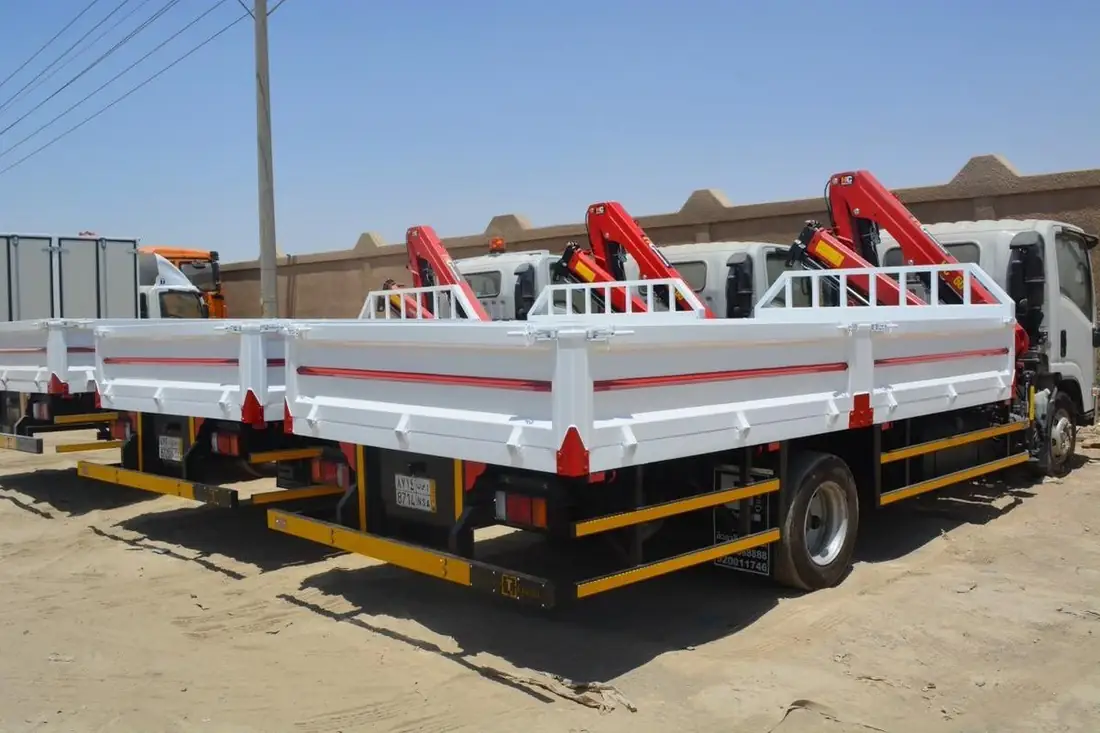
What exactly do we fabricate?
Our industrial work is turning a truck chassis into a specialised vehicle. That includes:
- The sub-frame: the intermediate layer between the truck frame and the build-up, whose job is to spread load along the frame rather than at points. A poor sub-frame is a leading cause of truck frames cracking after a year in service.
- Cargo bodies: with drop or fixed sides, chequered plate or marine ply floors, and heavy hinges and locks built for daily use.
- Tippers: with side doors for two-way or rear discharge, and a cylinder and operating pressure selected for the payload and tipping angle.
- Tanks: water tankers with anti-surge internal baffles, pumps, hose reels, valves and railed top walkways.
- Refuse compactor structures: with hydraulic compaction, ejector plate, sealed tailgate and anti-corrosion treatment.
- Trailers and semi-trailers: flatbeds with mesh or steel sides, and cable drum trailers.
Mounting equipment on the chassis
After fabrication we mount the equipment itself — knuckle or telescopic crane, aerial work platform, hook lift or anything else — and connect it to the vehicle's systems:
- Fitting the power take-off (PTO) on the gearbox at the correct ratio for the pump.
- Fitting the hydraulic oil tank sized to the pump flow, and relocating the fuel tank or battery box where needed.
- Routing hoses by the shortest path with the fewest bends to limit pressure loss and heat.
- Setting the relief valve to the equipment's design pressure, not above it.
- Fitting a pressure gauge and thermometer so problems are found before the pump burns out.
Calculations before fabrication
We do not start cutting before two numbers are established:
- Remaining net payload: permitted gross weight minus kerb weight minus the weight of the equipment, sub-frame, body and tools. What remains is the real payload — the number the customer must know before signing the order, not after.
- Axle load distribution: each axle must stay within its limit both stowed and working. A crane behind the cab loads the front axle; a long body loads the rear. That is settled by a moment calculation on paper before any steel is cut.
Finishing and compliance
Every vehicle is finished with blast cleaning, epoxy primer and a topcoat in the customer's colours and livery, then fitted with rear and side bumpers and reflective marking to Saudi traffic regulations, plus warning lighting where required. The vehicle is handed over after full functional testing with operating and maintenance manuals and a 12-month warranty.
We build on every major chassis make
Mercedes-Benz, Volvo, MAN, Scania, Renault, IVECO, DAF, ISUZU, FUSO, HINO, UD, Hyundai, Daewoo and TATA — and we can supply the chassis itself, new or used, at competitive prices.