The question comes up in nearly every enquiry: knuckle boom or telescopic? The answer depends far less on price than on the sites the truck will work every day.
The knuckle boom
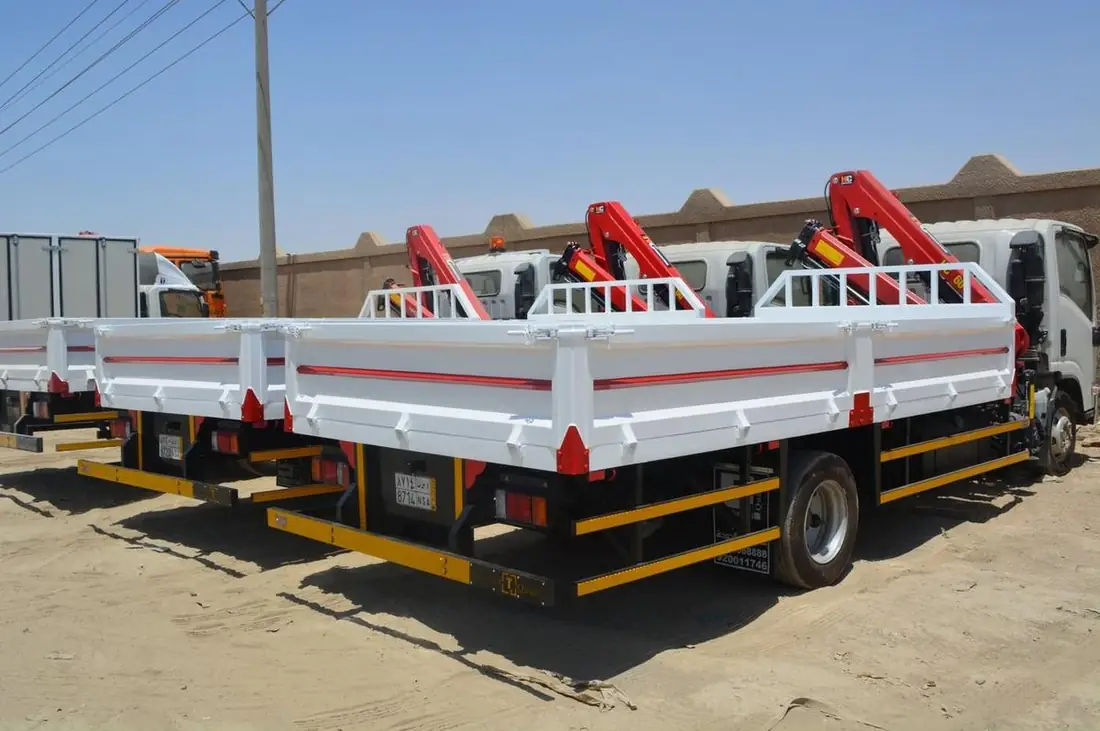
It folds compactly behind the cab, and its articulated joints let it reach behind obstacles, over walls and into tight openings. Its strengths:
- Small stowed footprint — leaving the longest possible cargo body.
- Three-dimensional reach — able to go below grade or around an obstruction.
- Fast cycles — shorter deploy-and-stow time on repeat deliveries.
- Lower weight for the same lifting moment.
Ideal for delivery trucks, building materials, marble and block plants, and urban service work.
The telescopic boom
A straight boom extending in one line. Its strengths:
- Highest direct lift height at the same capacity — best for placing a load on a roof or tower.
- Greater stability at full horizontal reach with heavy loads.
- Simpler operation — fewer axes means faster operator training.
Ideal for open construction sites, lifting tanks and HVAC units, and infrastructure work.
Remaining payload: the forgotten number
Every kilogram of crane comes off the truck's legal payload. A 1,800 kg crane on a chassis with 8 t net payload leaves you 6.2 t for cargo. Work this out before the purchase, not after the first overload fine.
Outriggers and ground
A crane only lifts its rated capacity with legs fully extended on ground that can carry them. On sand or hot asphalt you will need spreader pads, and in narrow streets full extension may be impossible — which is where the knuckle boom wins, because it works efficiently in the near zone.
Choosing, in short
| Situation | Better choice |
|---|---|
| Tight sites, repeat deliveries | Knuckle |
| High lifts onto roofs and buildings | Telescopic |
| Need the longest possible body | Knuckle |
| Heavy loads at long horizontal reach | Telescopic |
| Newly trained operator | Telescopic |
In every case the build-up decides half the outcome: sub-frame mounting, hydraulic pressure setting and the PTO drive path. Send us your chassis type and your duty cycle and we will recommend a model with the technical reasoning behind it.