
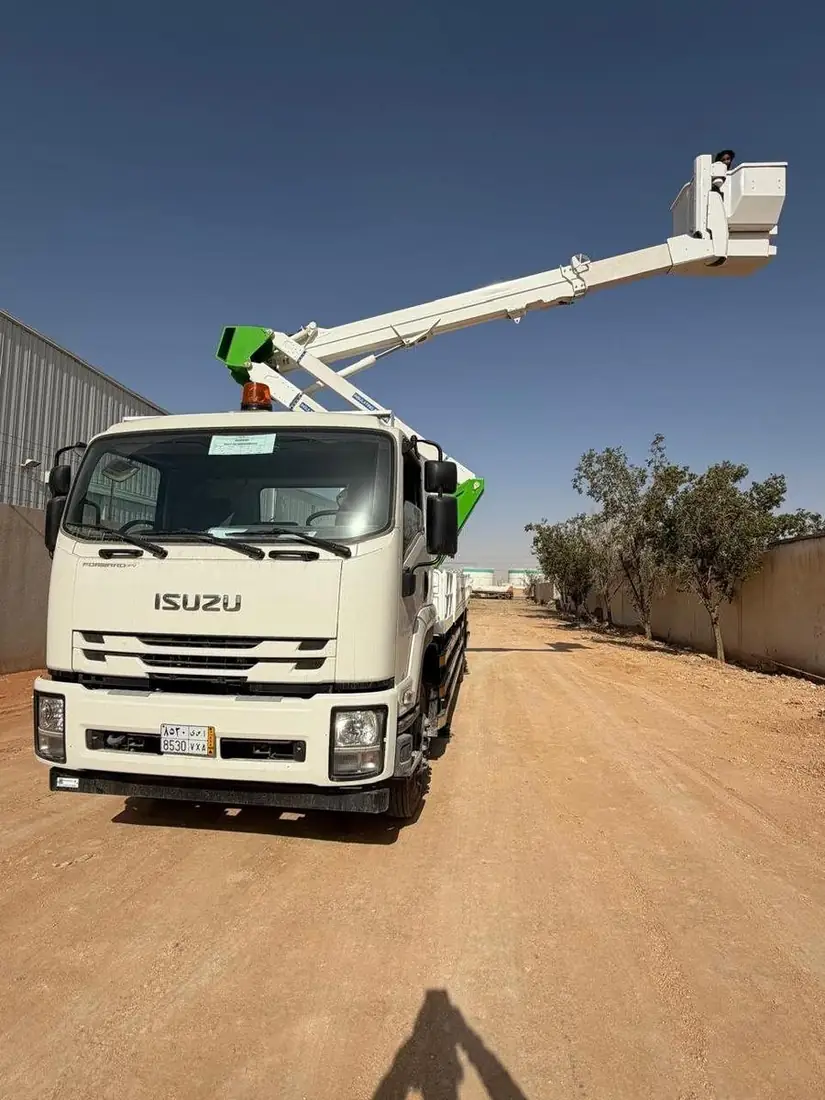
When a contractor wins the Unified Contract for electricity distribution networks, they face a mandatory equipment list with no room to negotiate. The item contractors most often stumble on is the 46 kV insulated aerial work platform — what the market simply calls the insulated basket.
Why 46 kV specifically?
Distribution networks in the Kingdom typically run at 13.8 and 33 kV. The number 46 is not the operating voltage — it is the tested insulation limit, providing a safety margin above the highest voltage a technician might contact. A platform rated below that is not accepted for live-line work regardless of build quality.
ANSI A92.2 and CAT C
The American standard ANSI A92.2 is the reference for insulated aerial devices, and CAT C within it means the platform is qualified up to 46 kV after documented periodic dielectric testing. What the tender file requires is not the word "insulated" but:
- A factory dielectric test certificate carrying the unit serial number.
- An explicit CAT rating within the standard.
- Retest intervals and validity period.
The upper boom is where insulation actually lives
Insulation does not come from paint. On a compliant platform the upper boom is built entirely from fibre-reinforced polymer, electrically isolating the basket from the truck structure. Platforms relying only on an external insulating sleeve fail periodic testing after limited sun and dust exposure.
Safety systems the inspector will ask about
- Outrigger interlock: blocks platform motion unless all four legs are correctly seated, and blocks leg retraction unless the platform is stowed.
- Safety valves on every cylinder, preventing sudden descent on hose failure.
- Hydraulic basket levelling keeping the floor horizontal throughout the boom envelope.
- Electric emergency pump to bring the technician down if the engine stops.
- Dual controls — one station in the basket, one on the deck.
The chassis is not a side detail
Much delivery delay comes from buying the platform first and hunting for a chassis afterwards. A typical requirement for a 16 m platform is a 4×2 chassis with a GVW of at least 18 t, 13 t net payload, a 6.5–7 m cab-to-axle distance, and a factory-fitted PTO. A chassis without PTO means dismantling the gearbox — at least two extra weeks.
A quick pre-purchase checklist
- Is the rating written explicitly: ANSI A92.2 — CAT C — 46 kV?
- Is the upper boom full fibre-reinforced polymer, not merely sleeved?
- Do the working height and outreach cover the tallest pole in the contract area?
- Is the basket capacity enough for two technicians with tools (270 kg as a practical minimum)?
- Does it include the earthing reel with a 15 m cable, required on most projects?
- Is the chassis compliant and PTO-equipped from the factory?
The difference between an accepted and a rejected offer is usually not the price — it is these clauses. If you hold a tender document or client specification, send it to us and we will return a clause-by-clause compliant technical offer.